
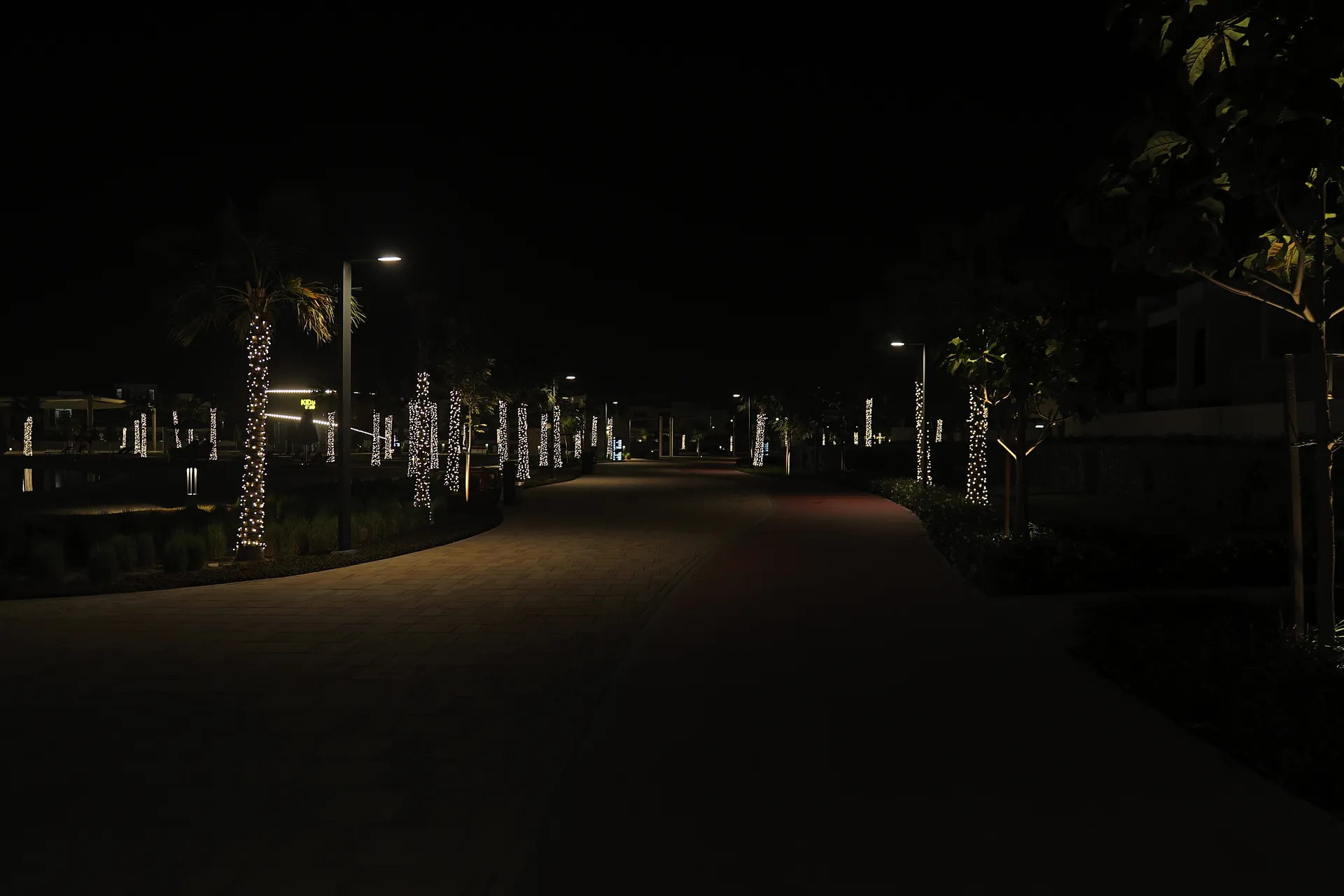
Most of a residential landscape is meant to stay dark after nightfall, and that is the part of the brief nobody writes down.
What stays dark
AL SHOLA ALMODEA designed, supplied and installed the external lighting across this district: the walkways, the plaza, the surrounds of the amenity buildings and the pool deck. The first decision on a job like this is what to leave alone.
A masterplan landscape is not a large garden. After dark its job is to get a resident from a car to a front door safely and without thinking about it. Everything beyond that is optional.
Lighting all of it is the common failure. An evenly bright landscape reads as a car park, costs more to run and destroys the thing residents bought, which is a quiet place to be at night.
The eye adapts to the brightest thing in view. A bright pole beside an unlit path makes the path look darker than it is, so what matters is the ratio between the lit surface and its surroundings, not the number on the meter.
Routes
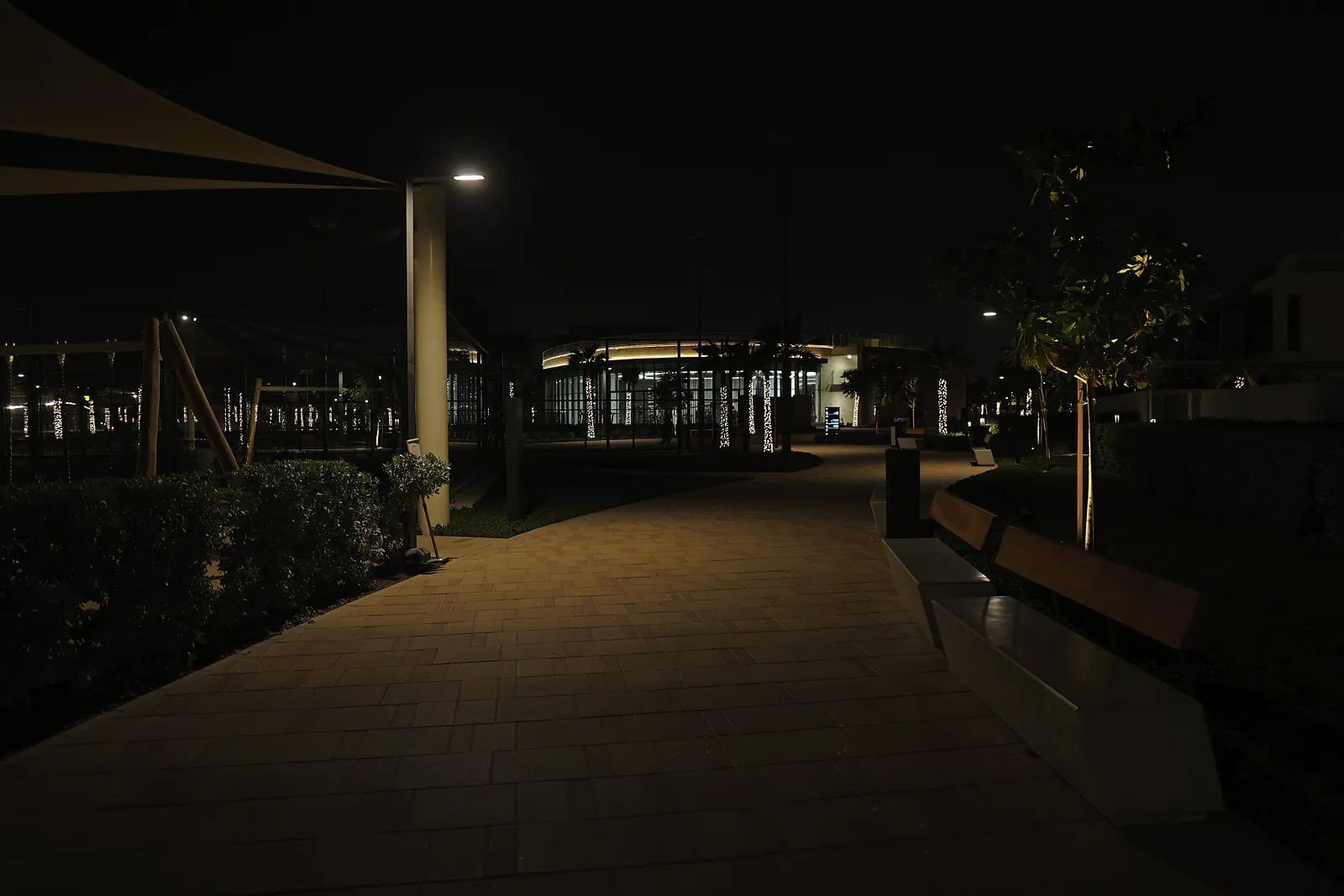
Poles along a route are easy to draw and easy to get wrong. The spacing is the design; the pole is just where it happens. Too wide for the mounting height and the path becomes a string of pools with darkness between them.
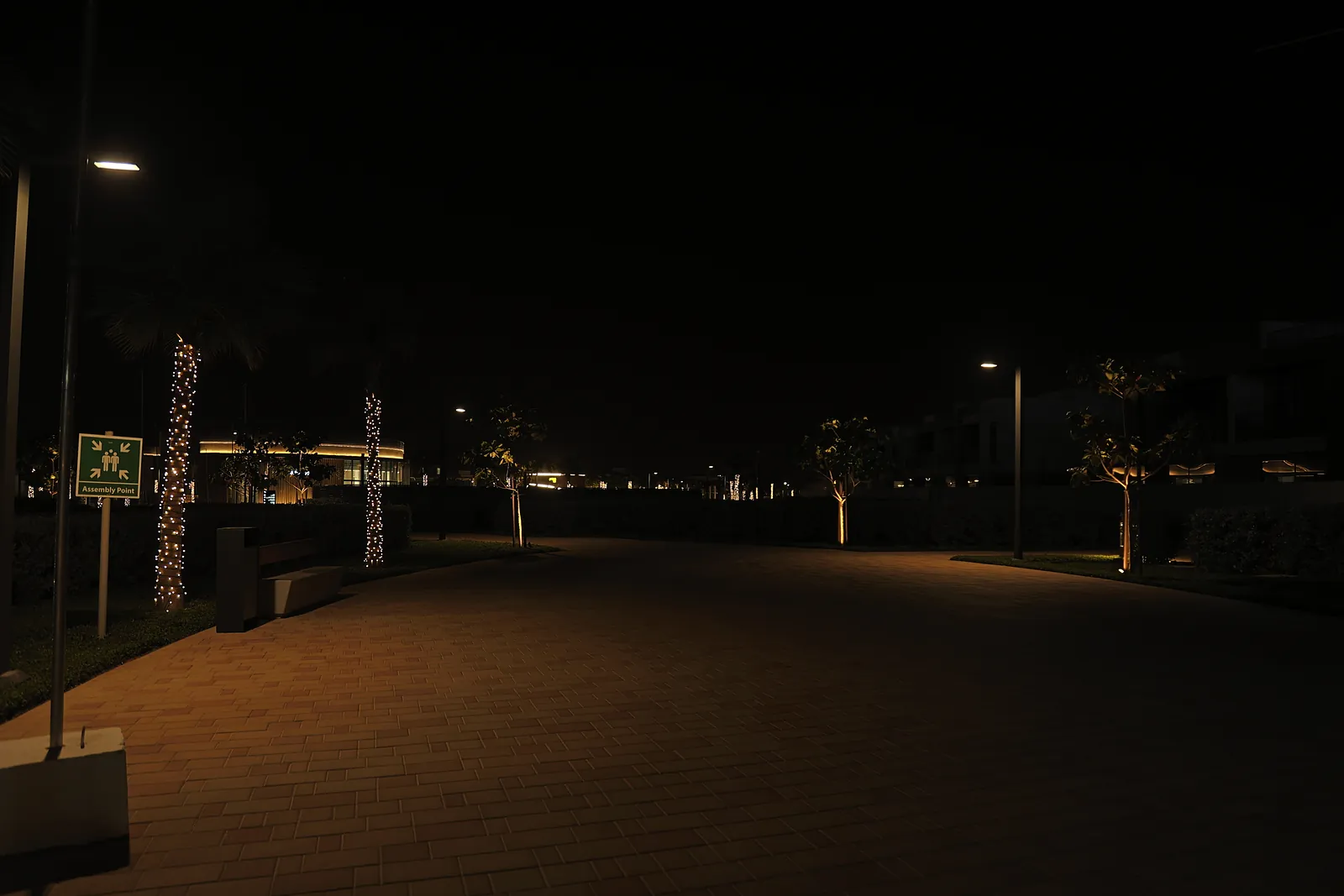
The places that earn light are where somebody has to decide something: a junction, a change of level, a threshold, where a footpath meets a road. Between those, a resident needs enough to read the ground and nothing more.
Spill shapes the rest. Houses face these paths, and a first-floor bedroom window is roughly at the height of a pole-top optic. Mounting height and cut-off are set by the nearest window, not the widest part of the path.
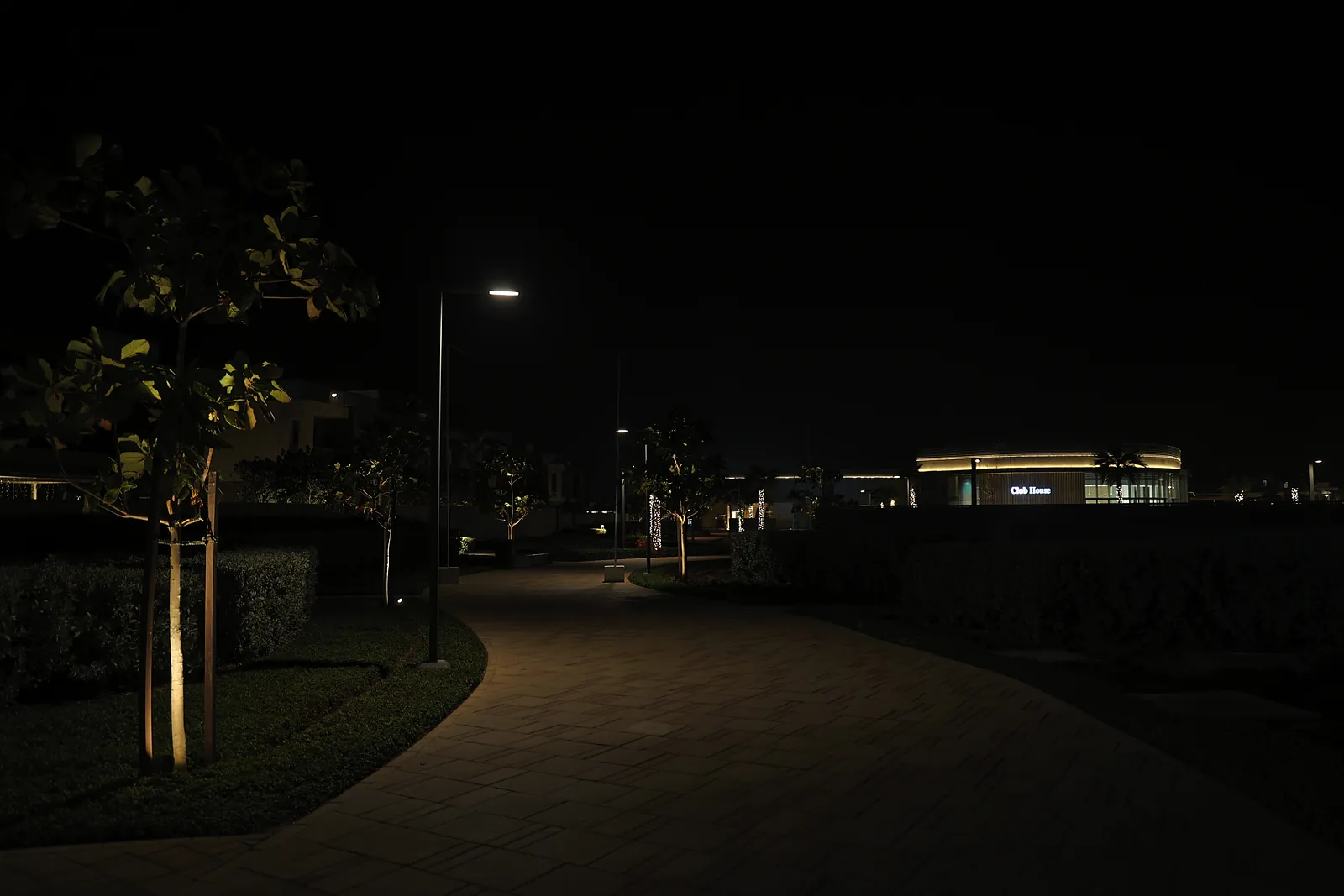
Planting is lit narrowly where it is lit at all. A tree taken from the base with a tight beam shows its structure and throws its shadow onto the surface behind. A wide beam lights the tree, the wall, the sky and the neighbour.
The clubhouse
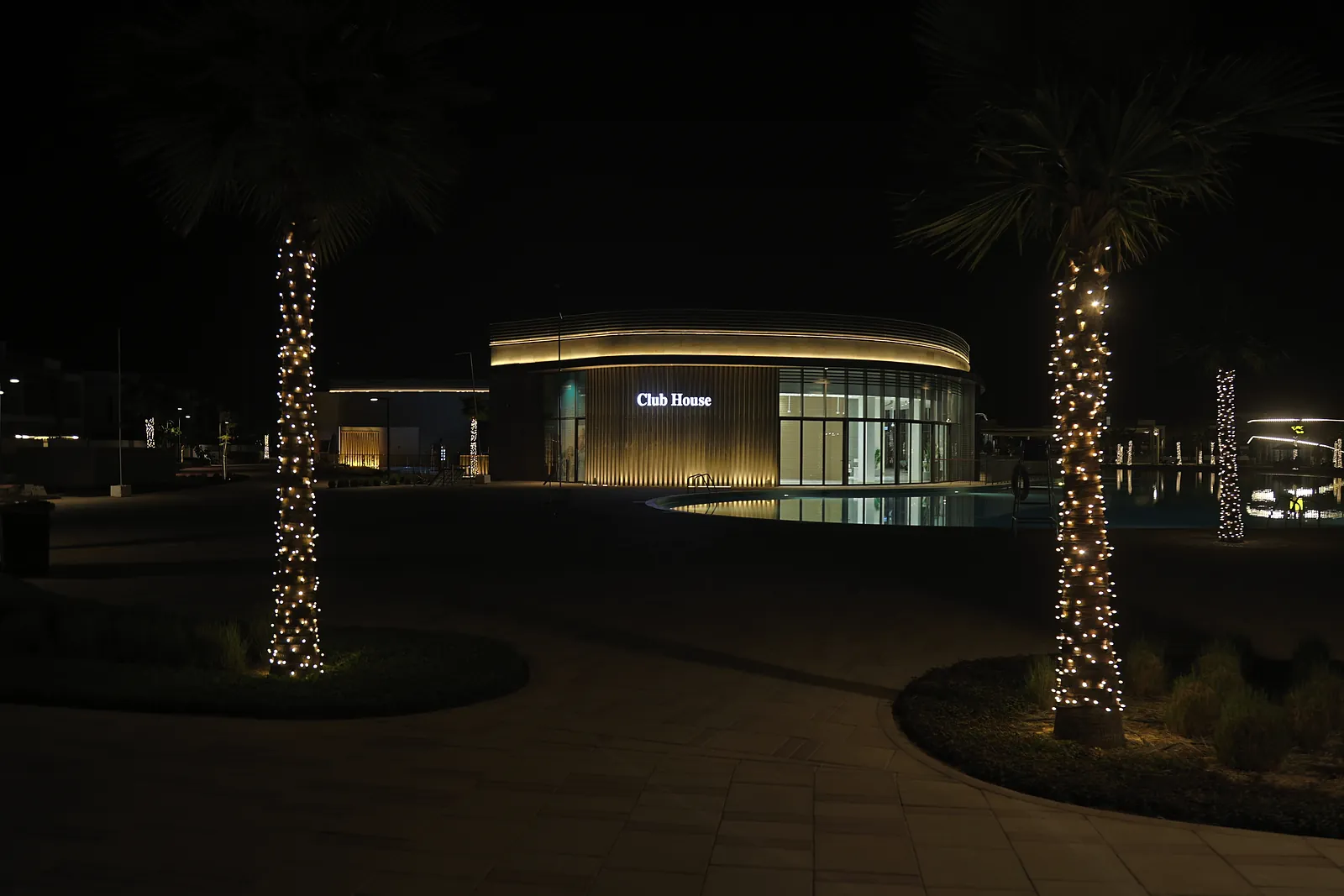
A district needs something to orient by. The clubhouse is visible from most of the plaza and much of the walkway network, so it carries a higher level. Everything around it is kept down so it can.
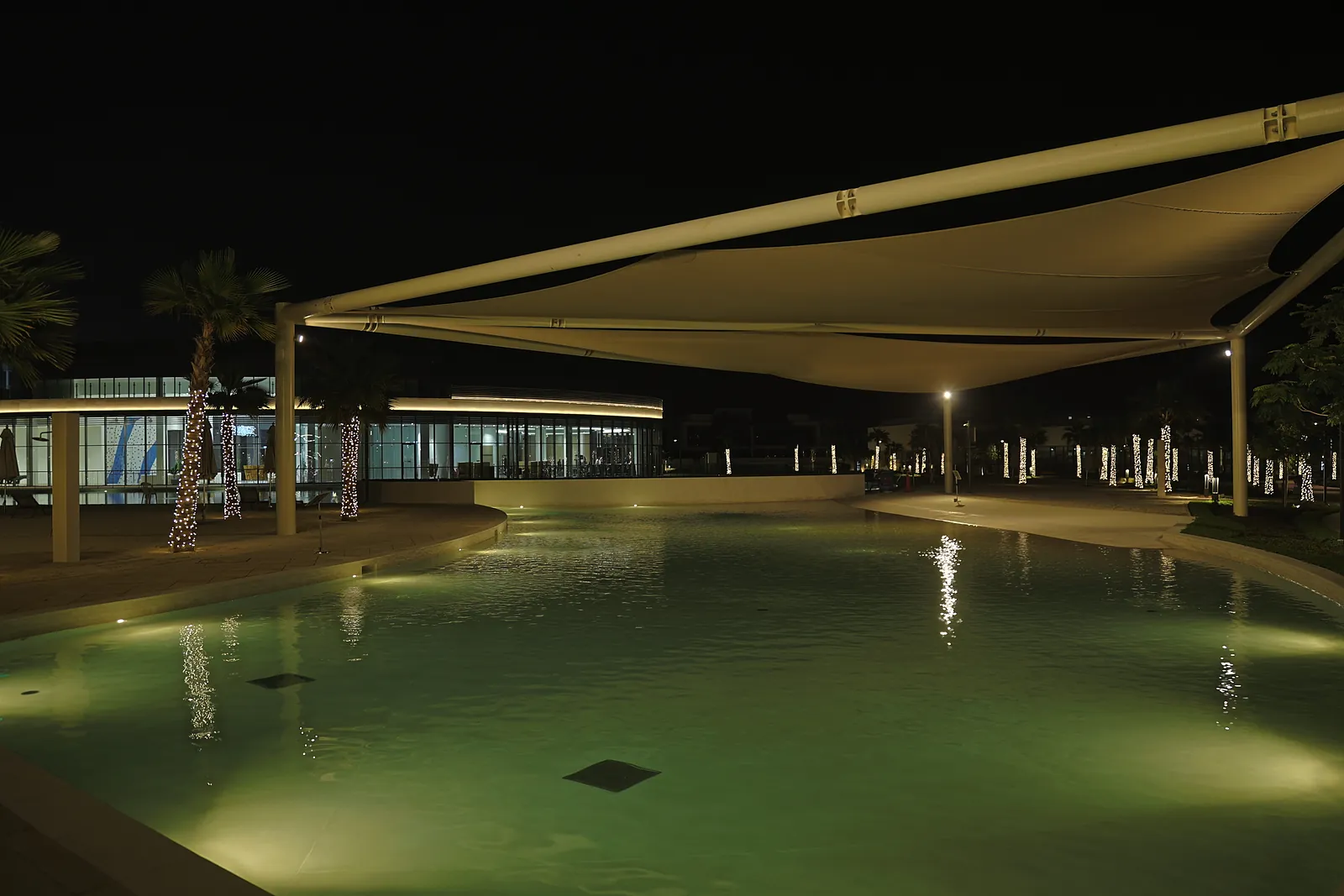
The lit band under the roof does that work, reading as a horizontal line at distance and identifying the building before any detail resolves. The signage sits on its own circuit: a name that stays lit when the building is closed is a wayfinding mark; one that switches with the building is not.
At the pool the canopy is lit from underneath, so the fabric stops being a shade and becomes the light source. That gives a large, soft, low-glare surface over the water, the one place on site where people look upward.
Below ground
Almost everything difficult about landscape lighting happens before anything is switched on.
Ducts and draw pits go in before the paving and before the planting. Once a landscape is complete, a new cable route means lifting paving or trenching a lawn. Draw pits at every change of direction cost very little at first fix.
Trenching happens before the trees. A trench cut across a root zone after planting takes roots with it, and the tree tells you two seasons later. Duct routes and root barriers belong on the same drawing as the soft landscape.
Irrigated soil is wet part of every day. Fittings in planting beds want an ingress rating chosen for standing water, glands made off properly, and joints in a draw pit where they can be reached.
Circuits are split so a fault in the planting does not take the footpath with it, and fittings are wired in a loop, so one failure is one dark fitting instead of a dark run.
Landscape lighting
The cheapest hour on a landscape scheme is the one spent agreeing duct routes with the soft-landscape drawing before either trade starts. Design, supply and installation across all seven emirates, with a 5-year warranty on the fittings we supply. Call +971 6 572 3204 or message us on WhatsApp. More of our work in the emirate is on the Dubai lighting page, and the rest of this category is on the landscape lighting projects page.