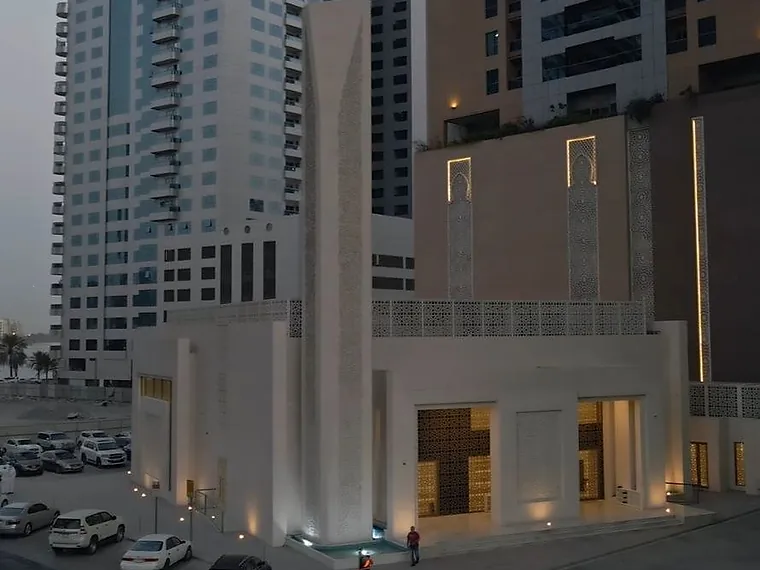
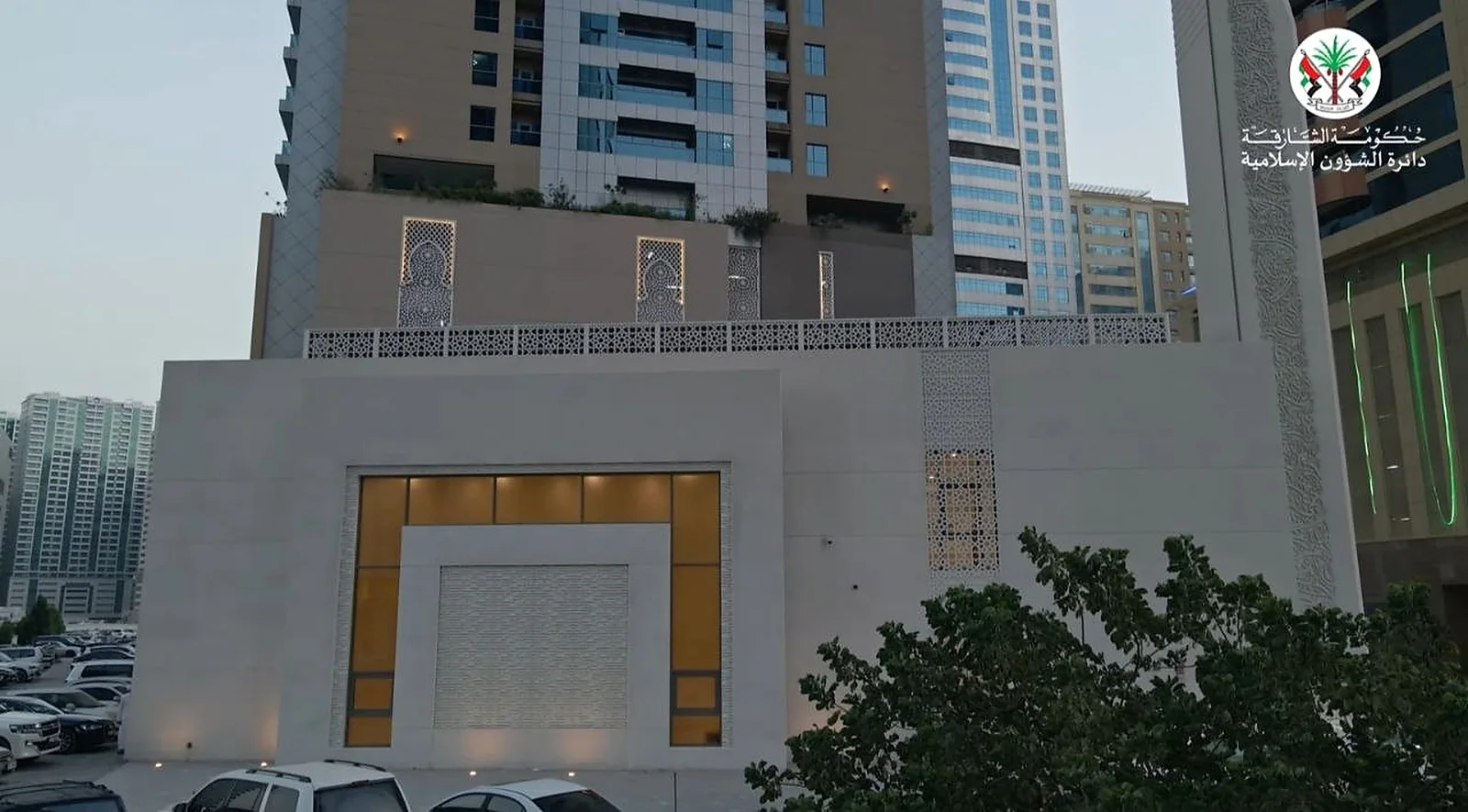
Prayer hall, minaret and facade lighting for mosques across the UAE, designed, supplied and installed by AL SHOLA ALMODEA.
Mosque lighting in the UAE
One physical fact shapes everything inside a mosque. A worshipper stands, bows, goes down into sujood and rises again, so the eyeline sweeps from carpet to ceiling and back many times in a few minutes. A fitting comfortable to a person standing can sit in the sightline of the same person rising. Glare in a prayer hall is judged from the floor, not the door.
The second is uniformity across the carpet. Worshippers line up on the rows the carpet sets out, and a bright patch beside a dim one is obvious to everyone in that row. Evenness matters far more than the headline level, and it is the number rarely asked for.
The mihrab and the minbar are the two places that carry emphasis, and modest emphasis is enough. They need to be found from the back of the hall, not spotlit.
Chandeliers are the traditional answer and often take most of the budget. A decorative fitting establishes the character of the hall and rarely lights the carpet evenly on its own. Pairing it with a discreet functional layer, recessed and invisible from below, is what makes both work, and lets the chandelier be chosen for how it looks.
People read in a mosque, from a printed Qur’an or a phone, seated on the floor and standing. That is a vertical task at two different heights, and the reason a hall lit only from a decorative centrepiece is harder to use than it looks.
Outside, the case for restraint is stronger than anywhere else we work. A mosque is a landmark with homes overlooking it, so upward spill goes into somebody’s window. Narrow beams from low positions, light kept on the stone, geometric screens lit from behind, one warm colour temperature, and nothing that changes or moves.
A committee usually asks first about running cost, which is decided by the control schedule rather than the fittings. A mosque is lit before dawn and after dark every day, and the two prayers falling in darkness move week by week with the calendar. A scheme switched to prayer times uses a fraction of the hours of one on a fixed clock, and is lit when people actually arrive.
Evening use peaks in Ramadan, with a full hall at isha and taraweeh. That is the condition to design and commission against, and the worst month in which to find a control problem.
We work across all seven emirates from a showroom in Industrial Area 7, Sharjah.
The work
Mosque lighting
Fajr, isha and Ramadan decide the control schedule, and the control schedule decides both the electricity bill and whether the building is lit when anyone is in it. Design, supply and installation across all seven emirates, with a 5-year warranty on the fittings we supply. Call +971 6 572 3204 or message us on WhatsApp.